Interview with Shar Arquitectura for EL MUNDO
Calle Mayor Principal 15,
34001 Palencia (España)
979 816 554
shar@shararquitectura.es
Calle Francisco Silvela, 104
28002 Madrid (España)
687 71 79 82
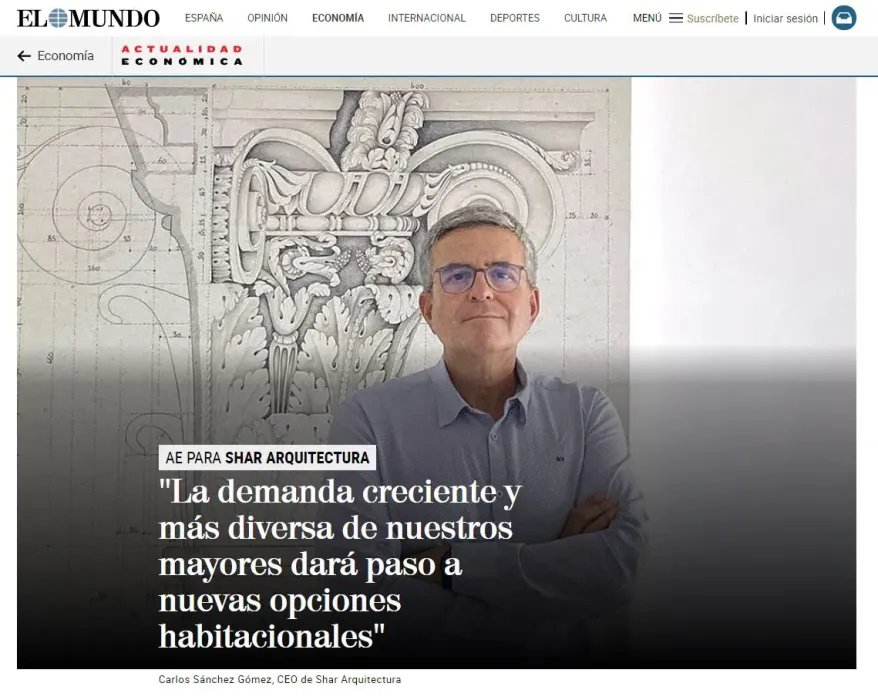
Shar Arquitectura was founded in 1999 by Carlos Sánchez Gómez, and since its inception, the majority of its professional activity has focused on the field of healthcare and social-healthcare architecture. As a result of this process of specialization, always hand in hand and in close collaboration with its clients (among which are the main Spanish and European social-healthcare providers), the nationwide studio has become a benchmark in the sector. Shar Arquitectura represents a group of more than 20 architects who share the same passion for their profession.
It’s odd to begin an interview with an architectural firm by talking about the evolution of the social-healthcare sector over the last 30 years, but in your case, it makes perfect sense, doesn’t it?
Even before Shar Arquitectura’s founding, 30 years ago, I was already aware of the importance of multidisciplinary work and the need for specialization in architecture. On a trip to Harvard University, I saw how this multidisciplinary work was implemented, how many MIT engineers collaborated with Harvard doctors. I wondered why such collaboration between other professionals, like us architects, was so unusual. Today, biomedical engineering is well known, but it still strikes us as odd that an architect might be asked about the social and healthcare sector.
Now, how has it evolved?
The beginnings of these types of centers were associated with the concept of an institution. Residents’ medical care took priority; the residences were public or managed by religious orders, and in the few private initiatives that operated, the concept of management efficiency prevailed. This vision was reflected in the architecture. The buildings resembled hospitals, their organization responding solely to concepts that had little to do with the residents’ quality of life. In recent years, this has been evolving. New models of care have emerged, focused on the elderly, and the challenge for architecture is to respond to each of these, to evolve hand in hand, and to incorporate the necessary nuances that help enhance the objectives of a care that is not unique, but diverse. We see how this multidisciplinary dialogue between the architect and professionals in care and management is bearing fruit.
And I suppose these changes must have been accompanied by regulatory and legislative changes…
It’s been more than 10 years since I traveled to Sweden and Germany to experience firsthand this model of person-centered care, which is becoming a paradigm for many to follow. Only Castile and León, the Basque Country, and Navarre had adapted their regulations to this Coexistence Unit model, but with the arrival of the pandemic and what we’ve experienced in various nursing homes around the world, it seems that legislative updates are accelerating in other communities, and it’s very likely that the new regulations will follow this same path.
“Thirty years ago, I was already aware of the importance of multidisciplinary work and the need for specialization in architecture.”
What does this new model entail?
It’s about prioritizing the resident’s well-being, restoring their ability to choose. The building ceases to be an institution and becomes the resident’s home. This has an impact on the architecture, which must be scaled down, by adding smaller modules where residents and caregivers meet and live together as they would in a home. Reflecting the management philosophy in the architecture itself is essential.
What other demands are you currently facing at Shar Arquitectura?
We’ve talked about senior residences, but the truth is that there are many other demands in the sector, for example, residences for the disabled and mental health (addictions, eating disorders, etc.), which are of paramount importance in these times.
And looking back over these 30 years of history and the current situation, how do you see the future of the sector?
Social and healthcare management is becoming increasingly professionalized; it’s no longer just about charitable institutions. We have many professionals in geriatrics, mental health, and medicine reflecting on how these people should live. It’s essential that we architects participate in this debate. To do so, we will have to learn from them and know how to translate their needs into our language, which is architecture. In the field of seniors, new housing models should be studied. It’s not just about debating what nursing homes should be like, but also asking whether these homes are the only solution. We live in an increasingly aging society, yet the elderly are arriving at nursing homes later and later, highly dependent, and their average length of stay is
*This text was developed by UE Studio, a creative branded content and content marketing firm from Unidad Editorial, for SHAR ARQUITECTURA.